

Flooring guide
What is the best flooring for a kitchen?
For most kitchens, it is LVT. Here is why, when we would choose something else, and how each floor copes with water, wear and underfloor heating.
9.9/10 across 47 Checkatrade reviews
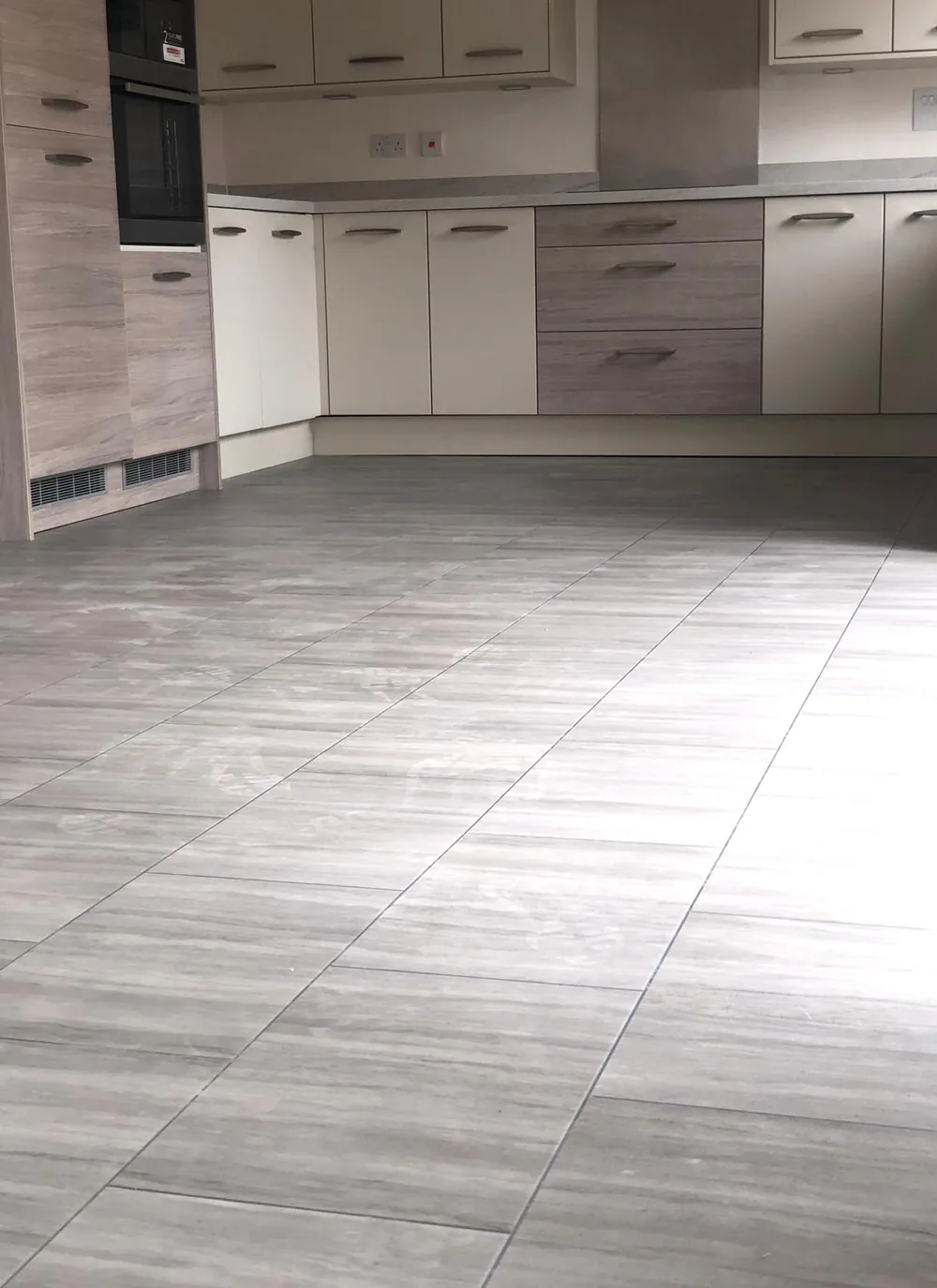
For most kitchens, we would fit LVT. Water sits on top of it rather than soaking in, it is warmer and quieter underfoot than tile, and it works over underfloor heating. If you want real timber, engineered wood is the alternative, as long as spills are wiped up rather than left.
The right answer still depends on the kitchen. A busy family kitchen with a dog, an open-plan kitchen-diner, a kitchen going in next month and a kitchen staying put all point to slightly different floors.
At a glance
- LVT is our first choice for most kitchens. Karndean calls its LVT waterproof and stain resistant
- Engineered wood suits a kitchen, says Which?, but not a room with high humidity
- Laminate works in a kitchen only in a range made for water, and standing water still needs wiping up
- Solid wood is not normally suitable for a kitchen, says Which?
- Porcelain and stone tile are hard wearing but cold and noisy without underfloor heating. That is a tiler’s job
The best kitchen floor, by situation
This is how we would choose.
| Your kitchen | What we would fit |
|---|---|
| Busy family kitchen, children, pets | Glue-down LVT |
| Open-plan kitchen-diner, one floor throughout | LVT, or engineered wood if you want real timber and will wipe up spills |
| Kitchen with underfloor heating | Glue-down LVT or engineered wood |
| Period house, real wood in the rooms next door | Engineered wood or parquet |
| Utility room, rental or downstairs toilet | LVT or sheet vinyl |
| You want the look of stone and a very hard surface | Porcelain or stone tile, fitted by a tiler |
Kitchen flooring compared
| Floor | Water and spills | Wear and dropped pans | Underfoot | Underfloor heating |
|---|---|---|---|---|
| LVT | Waterproof and stain resistant (Karndean) | Clear wear layer. A glued plank can be lifted and replaced | Warmer than stone (Karndean) | Yes |
| Engineered wood | Suits kitchens, not high humidity (Which?) | Real wood can dent. The top layer can be sanded back | Warm, real timber | Yes |
| Solid wood | Not normally suitable for kitchens (Which?) | Can be sanded many times | Warm, real timber | Not suitable (Which?) |
| Laminate | Only ranges made for water. Wipe up standing water | AC3 suits heavy home traffic (Which?) | Harder and louder than vinyl | Yes, on many ranges |
| Sheet vinyl | Few joins for water to find | Less durable than LVT (Which?) | Cushioned ranges feel softer | Check the range |
| Porcelain or stone tile | Won’t rot or warp when wet (Which?) | Very hard surface | Cold and noisy without heating (Which?) | Conducts heat best (Which?) |
Which kitchen floor copes best with water?
LVT. It is made of vinyl, so water has nowhere to go. Karndean describes its floors as waterproof and stain resistant, and says spills and accidents won’t cause warping or marks (Karndean, What is LVT flooring?).
Engineered wood has a real-wood surface. Which? lists it as suitable for kitchens, but advises avoiding it in rooms with high humidity (Which?, Types of wood flooring). In a kitchen, that means wiping up spills rather than leaving them.
Solid wood is the one we steer people away from. Which? says it isn’t normally suitable for kitchens, because it swells in hot, humid conditions and shrinks in the cold.
Laminate depends on the range. Quick-Step says its Hydroseal coating stops water getting into the grooves, and still recommends removing standing moisture as soon as reasonably possible (Quick-Step, Can I use Quick-Step laminate in my kitchen?). Our LVT vs laminate guide covers what happens when the dishwasher leaks.
Wear and comfort: dropped pans and long evenings standing
Porcelain tile and a good LVT are the hardest wearing, in different ways.
LVT has a clear wear layer over the design, and the thickness of that layer decides how it lasts. Amtico’s Signature range, for example, has a 1mm wear layer. If a pan does mark a glued floor, we lift that one plank and replace it. It is also softer and warmer than stone, which you notice in the room you stand in most. Our Amtico vs Karndean guide sets out the wear layer of each range.
Engineered wood is real timber, so a dropped pan can dent it. Which? describes the top layer as about 4mm of real wood that can be sanded back and refinished.
Tile is very hard, won’t rot or warp, and is easy to clean. The same hardness is the downside: it is cold without heating, noisy to walk on, and a cracked tile has to be cut out. If you want the look of stone without that, a stone-effect LVT is the alternative we fit.
Underfloor heating
Most of these floors can go over it. Which? says tiles and stone conduct heat best, that most engineered wood, vinyl and laminate can be used, and that solid wood is unsuitable because temperature changes can warp it.
Glue-down LVT and engineered wood are the two we would usually suggest over a heated kitchen. Each maker sets a maximum temperature and a way of bringing the heating back up after fitting. Our guide to engineered wood vs LVT sets out those limits, and our guide to glue-down vs click LVT covers the adhesive.
Open-plan kitchen-diners
Most people want one floor running through without a break. It has to cope with the kitchen end and still look right at the dining end.
LVT does both. A good wood-effect LVT handles the sink and the dishwasher, and reads as a wood floor across the rest of the room. Engineered wood also runs through well if real timber matters to you. Look after the kitchen end: wipe up spills, and put a mat in front of the sink.
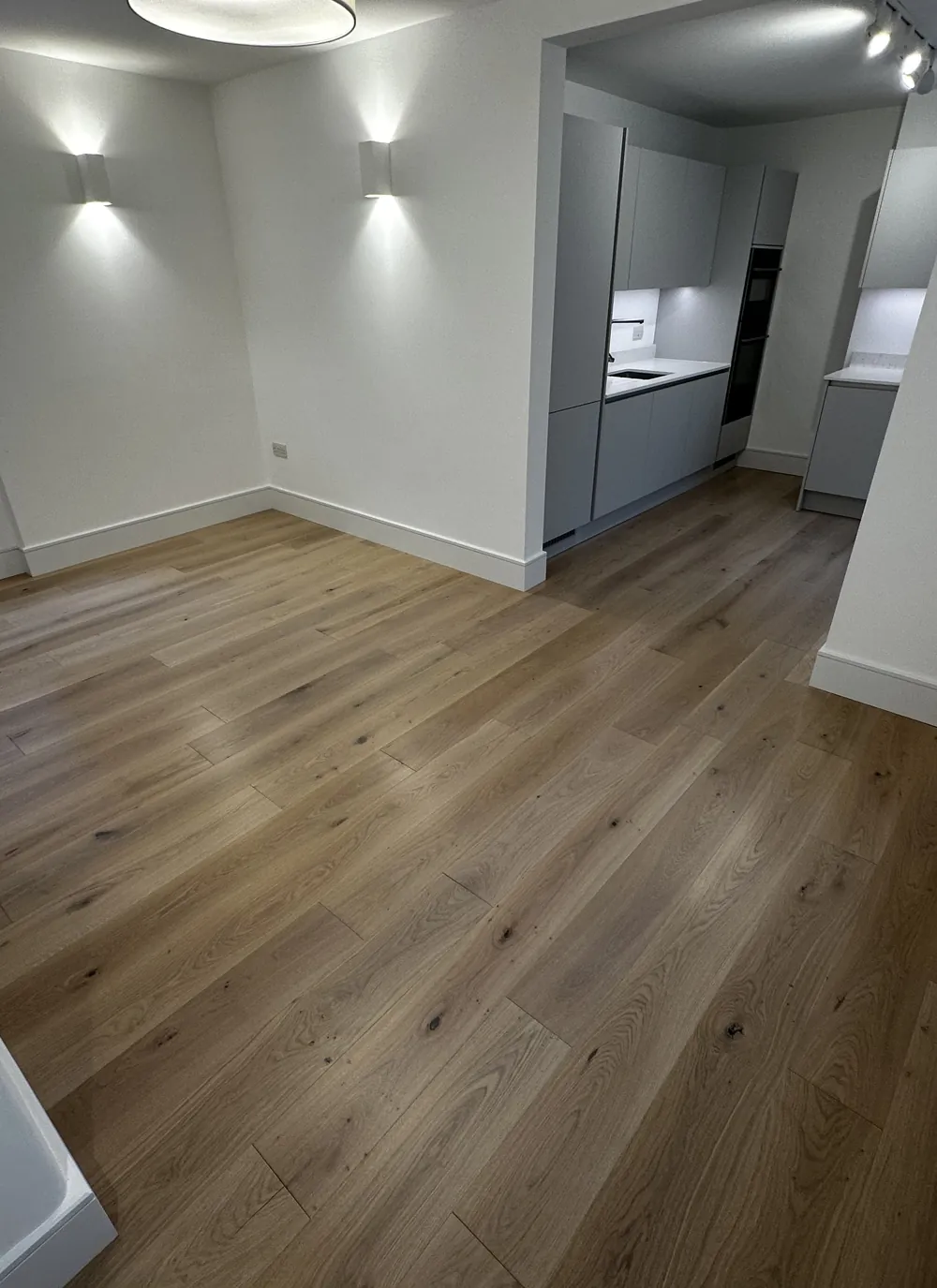
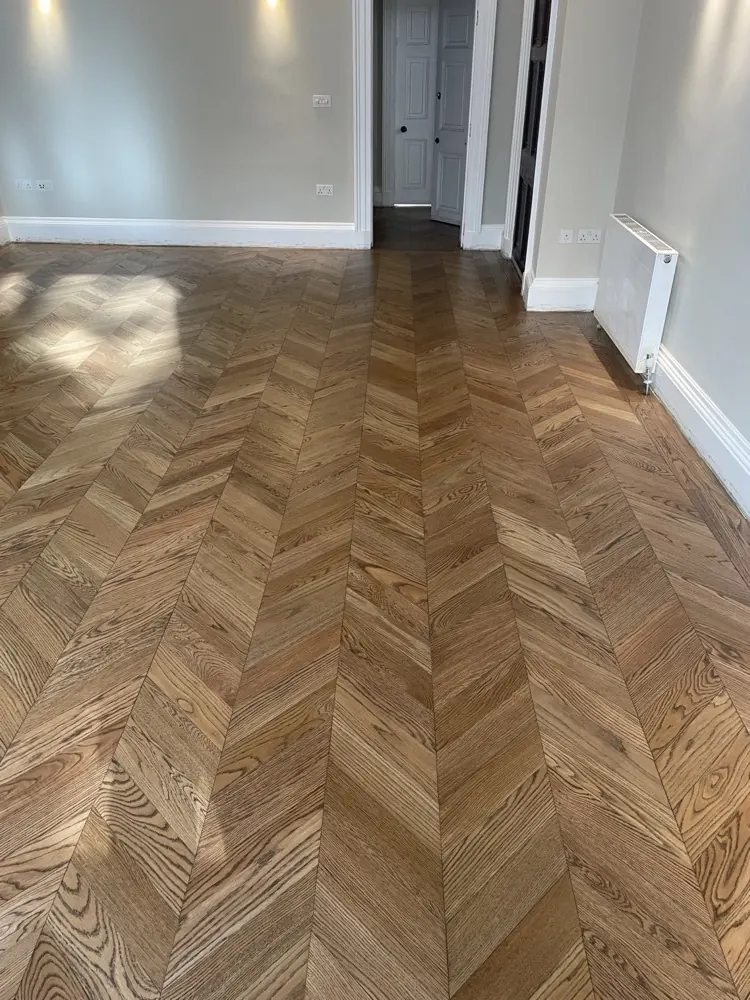
If the room has a natural break, such as an island or a step, you can change floors there instead: LVT in the kitchen and engineered wood in the living space, matched in tone. On a large floor, a herringbone or chevron in glue-down LVT or parquet sets out the space without changing material. We bring samples so you can see them side by side.
Before or after the kitchen goes in
Settle this early, because it changes how much floor you buy and when we come.
Glue-down LVT: usually after. The kitchen goes in first and we cut the floor neatly to the plinths. You don’t pay for floor hidden under cabinets, and the new floor is not underfoot while the kitchen is fitted.
Floating floors: plan the edges. Click LVT and laminate float, and need an expansion gap at the walls, so we don’t trap them under heavy fixed units.
Whichever order, check three things with your kitchen fitter:
- Appliance spaces. Run the floor into the dishwasher and fridge spaces, so the appliances slide out later without catching.
- The new floor height. A new floor, plus any levelling, raises the floor. Check the dishwasher still fits under the worktop.
- Who fits the plinths. Agree who takes them off and who puts them back.
What a kitchen floor costs with us
A worked example from our from-rates, fitted, excluding preparation:
| Kitchen | Area | LVT, from £70/m² | Engineered wood, from £95/m² |
|---|---|---|---|
| Galley kitchen | 8m² | From £560 | From £760 |
| Family kitchen | 15m² | From £1,050 | From £1,425 |
| Open-plan kitchen-diner | 30m² | From £2,100 | From £2,850 |
Preparation is priced at the survey, because it depends on what is under your current floor. Glue-down LVT is thin and bonded down, so it shows every dip beneath it. Old tiles may need lifting, old pipe runs may have left patches, and a concrete floor needs a moisture test before any wood goes on. Our guide to whether your subfloor needs levelling shows how to check yours. Whatever it needs goes in the same fixed quotation, so the figure does not move on the day.
We fit kitchen floors across Hertfordshire, Essex and London, including Hertford and Ware, Hoddesdon and Broxbourne and Bishop’s Stortford. Our residential flooring page shows the floors we fit room by room. For a fixed price for your own kitchen, book a free survey.
Sources
All pages read on 25 November 2026.
- Karndean Designflooring, What is LVT flooring? (UK): waterproof and stain resistant, warmth, underfloor heating
- Amtico, Pet-friendly flooring that lasts: Signature 1mm wear layer
- Which?, Types of wood flooring (27 Jan 2026): engineered and solid wood in kitchens, tiles, laminate AC rating, LVT vs vinyl roll
- Which?, Underfloor heating pros and cons (27 May 2026): suitable floor coverings
- Quick-Step, Can I use Quick-Step laminate in my kitchen?: Hydroseal, standing water
- Guild Floors published prices: guildfloors.co.uk/flooring-services/
Questions
Common questions
What is the best flooring for a kitchen in the UK?
For most kitchens, LVT. Karndean describes its LVT as waterproof and stain resistant, it is warmer underfoot than stone, and it works over underfloor heating. With us, LVT starts from £70/m² fitted, excluding preparation.
What is the hardest wearing kitchen flooring?
Porcelain tile and a good LVT with a thick wear layer are the hardest wearing. Tile won't rot or warp when wet, but Which? notes it can be cold and noisy without underfloor heating. LVT is softer and warmer, and on a glued floor one damaged plank can be lifted and replaced.
Is vinyl or laminate better for a kitchen?
Vinyl, in most kitchens. LVT is made of vinyl, so water does not get into it. Some laminate is now made for kitchens, such as Quick-Step's Hydroseal ranges, but Quick-Step still advises wiping up standing water as soon as you can.
Can you put engineered wood in a kitchen?
Yes. Which? lists engineered wood as suitable for kitchens, but advises avoiding it in rooms with high humidity. Spills need wiping up, and the real-wood top layer can be sanded back and refinished if it is marked.
Should kitchen flooring go down before or after the units?
For glue-down LVT, usually after. The floor is cut to the plinths, so you do not pay for floor hidden under cabinets and it is not under the kitchen fitters' boots. Plan the appliance spaces and the new floor height with your kitchen fitter first.
What is the best kitchen floor with underfloor heating?
Which? says tiles and stone conduct heat best, and that engineered wood, vinyl and laminate can all be used. Solid wood is the one to avoid. Glue-down LVT and engineered wood are the two we would usually suggest over a heated floor.
Choosing a floor for your kitchen?
We bring samples to your home, check the subfloor, and give you one fixed quotation that includes the preparation. The price we quote is the price you pay.
- Tell us the rooms and your postcode.
- We send appointment options within one hour, then survey your home for free, with samples.
- You get one fixed quotation. The price we quote is the price you pay.
Or call 01279 942302