

Flooring guide
Engineered wood or LVT? Which is better for your home, and what each costs fitted
We fit both. Here is how we would split a family home between them, and what each costs.
9.9/10 across 47 Checkatrade reviews
If you are choosing between engineered wood and LVT, we would usually fit LVT in the kitchen, hall, bathroom and utility room, and engineered wood in the living room, dining room and bedrooms. LVT starts from £70/m² supplied and fitted with us, and engineered wood from £95/m², both excluding preparation.
The difference that matters most in a family home is water. Engineered wood has a real timber surface, and LVT is made of vinyl, so they behave very differently when the dishwasher leaks or the dog comes in wet.
At a glance
- LVT, luxury vinyl tile, is made of vinyl layers under a clear wear layer
- Engineered wood is a real-wood top layer on a stable multi-layer core
- Karndean’s LVT suits kitchens, bathrooms and utility rooms, but not rooms that are continually wet
- Which? advises avoiding engineered wood in rooms with high humidity, such as bathrooms
- Both go over underfloor heating, within the maker’s 27°C limit
- Engineered wood can be sanded back and refinished. LVT cannot
- LVT from £70/m², engineered wood from £95/m², supplied and fitted, excluding preparation
Engineered wood vs LVT at a glance
| LVT | Engineered wood | |
|---|---|---|
| What it is | Layers of vinyl: a backing, a printed design and a clear wear layer | Three or four layers of wood glued together, with a real-wood top layer of about 4mm |
| Water | Karndean calls its floors waterproof and stain resistant, though not for rooms that are continually wet | Best avoided in rooms with high humidity, such as bathrooms (Which?) |
| Underfloor heating | Yes. Karndean: no more than 27°C where the adhesive meets the subfloor | Yes. Havwoods: no more than 27°C at the surface of the wood |
| Damage | Glue-down: lift and replace the one damaged plank | Sand back and refinish the wear layer |
| Feel and look | A printed wood or stone design | Real timber grain, every board different |
| Herringbone | Glue-down is laid piece by piece, so any pattern is possible | Laid as parquet blocks, in herringbone or chevron |
| Subfloor | Glue-down needs a smooth, flat base, because it shows every dip | Needs a flat, dry, sound base |
| Supplied and fitted with us | From £70/m², excluding preparation | From £95/m², excluding preparation |
Is LVT cheaper than engineered wood? Cost per m², fitted (2026)
LVT starts from £70/m² supplied and fitted with us, and engineered wood from £95/m², both excluding preparation. On a 20m² living room, that is from £1,400 in LVT or from £1,900 in engineered wood, before preparation.
| Room | Area | LVT, from £70/m² | Engineered wood, from £95/m² |
|---|---|---|---|
| Hall | 8m² | From £560 | From £760 |
| Kitchen | 15m² | From £1,050 | From £1,425 |
| Living room | 20m² | From £1,400 | From £1,900 |
Preparation is priced at the survey, because it depends on what is under your current floor, and it goes in the same fixed quotation. Our wood flooring cost guide breaks down what preparation covers and what solid hardwood and herringbone cost.
Which is better for a family home, room by room?
Kitchen and utility room. These are the rooms where water ends up on the floor, so this is where LVT earns its place. Karndean’s UK installation guidelines say its floors suit traditional residential bathrooms, kitchens and utility rooms.
Hall. The hall takes the most footfall in the house, plus wet shoes, buggies and dogs. LVT copes with all of it.
Bathroom. LVT handles the splashes of a family bathroom. Which? advises avoiding engineered wood in rooms with high humidity, such as bathrooms.
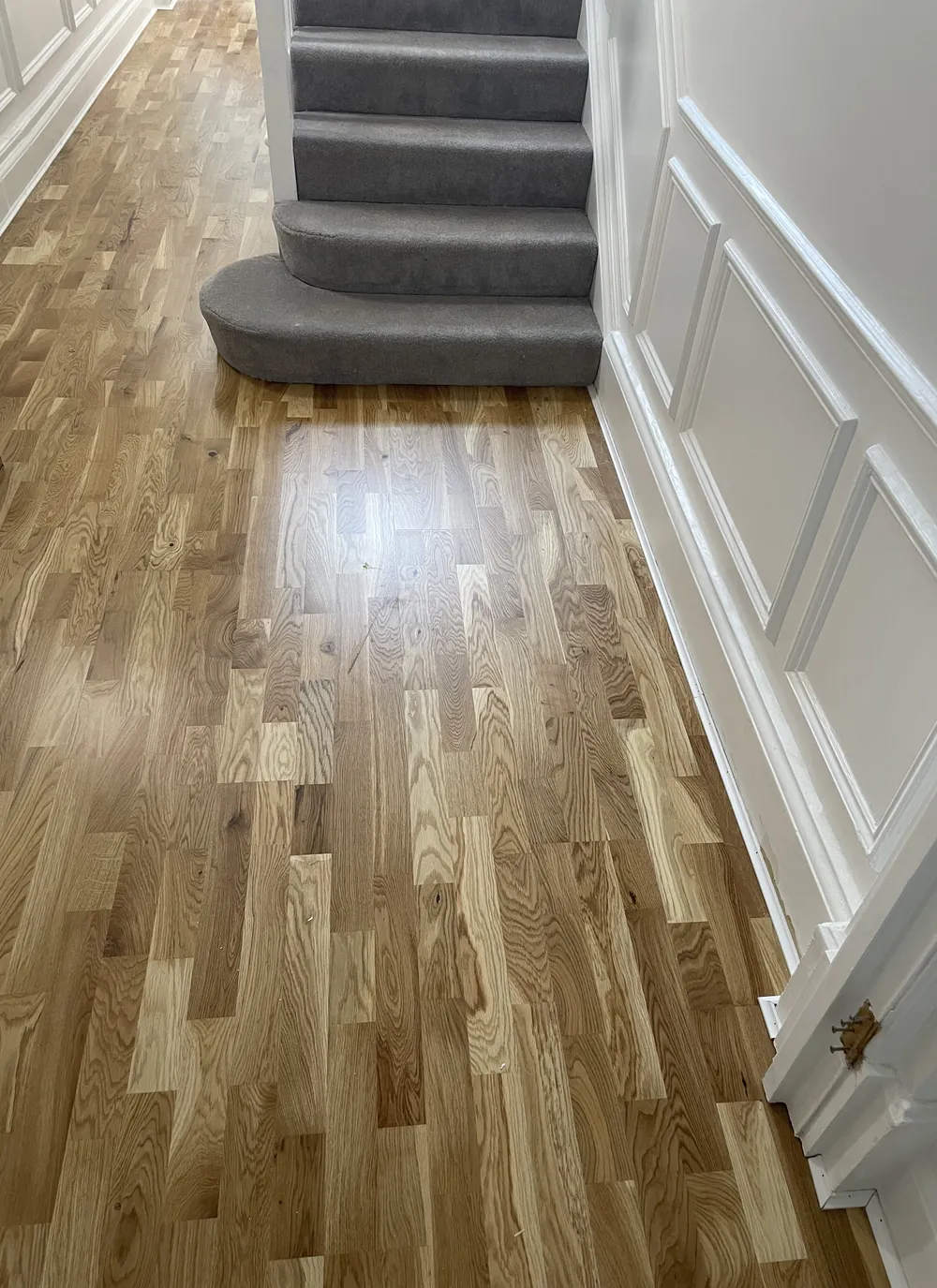
Living room, dining room and bedrooms. These are dry rooms, and this is where engineered wood is worth the extra. You get real timber, and the top layer can be sanded back and refinished if it is marked.
Open-plan kitchen and living space. You can run one floor through the whole space, or change at a natural break such as an island or a step. If it is one floor through a kitchen, LVT is the safer choice.
Which copes better with water, spills and pets?
LVT is the safer floor anywhere water ends up. Karndean describes its floors as waterproof and stain resistant, and suitable for kitchens, bathrooms, halls and utility rooms. Its installation guidelines add that they are not for rooms that will be continually wet.
Engineered wood has a real-wood surface. Which? says it suits most living spaces, including kitchens, but advises avoiding it in rooms with high humidity. It can also change shape over time, though it resists warping better than solid wood.
If you have a dog, LVT is the floor we recommend for the hard-working family rooms. It shrugs off spills and claws.
Is engineered wood or LVT better over underfloor heating?
Both go over underfloor heating, and both makers set a 27°C limit, measured at different points. The practical difference is how the heating is brought up after fitting.
LVT. Karndean’s UK glue-down guidelines say the temperature where the adhesive meets the subfloor must not go above 27°C. The heating is commissioned first, switched off 48 hours before, during and 48 hours after fitting, then raised by no more than 2°C a day (Karndean gluedown installation guidelines, UK).
Engineered wood. Havwoods’ guidance keeps the surface of the wood at no more than 27°C, with temperature probes in the floor build-up to control it. The heating should be commissioned and running for at least three weeks before the boards arrive. After fitting, it goes up by no more than 2°C every 24 hours, and the room should stay at 45% to 65% relative humidity (Havwoods, engineered wood over underfloor heating).
Engineered wood is the right call over underfloor heating if you want real wood, because a solid board would move. Glue-down LVT is one of the best floors to put over it. Our guide to glue-down or click LVT covers the adhesive side. Electric underfloor heating is worth checking separately. Topps Tiles, for example, lists its LVT ranges for water-fed systems only and its engineered wood for water-fed and electric, both to a maximum of 27°C (Topps Tiles, LVT vs engineered wood). Whichever you choose, check the maximum temperature and the type of heating in the guidance for your floor before you set the heating.
Which lasts longer, and can you repair it?
Engineered wood can be refinished, and LVT can be repaired plank by plank. That is the real difference in how each one ages.
Which? describes the top layer of an engineered board as a real-wood veneer of about 4mm, which can be sanded back and treated to restore the finish if it is damaged. LVT has a clear wear layer over a printed design, so a deep scratch cannot be sanded out. On a glued LVT floor, we lift the damaged plank and replace it.
We can usually repair or match an existing hardwood or parquet floor. Send us a photo and we will tell you whether repairing or replacing is the better spend.
If you have chosen LVT, the wear layer you pick decides how it lasts. Our comparison of Amtico and Karndean sets out the wear layer and warranty of each range.
What subfloor does each one need?
Glue-down LVT needs the smoothest base of any floor here. It is thin and bonded down, so it shows every dip and hump underneath it. Karndean asks for a subfloor that is firm, hard, flat, level, smooth, dry and clean.
Engineered wood needs a flat, dry, sound base too, and concrete or screed needs a moisture test before any wood goes down. Our guide to whether your subfloor needs levelling shows how to check yours with a straightedge.
We survey the subfloor and price the preparation before the job starts, so it is in the quotation and the figure does not move.
Which would we choose for a whole house?
For most family homes, both. LVT downstairs where the water and the traffic are, engineered wood in the rooms where you sit and sleep. Matching the tone of the two across a doorway takes care, so we bring samples to your home at the survey.
If you are also weighing up laminate, our guide to LVT vs laminate compares the two room by room. Our residential flooring page shows the floors we fit.
Sources
All pages read on 16 November 2026.
- Karndean Designflooring, What is LVT flooring? (waterproof and stain resistant, suitable rooms, underfloor heating, cleaning): karndean.com/en-gb/floors/inspiration/discover/what-is-lvt-flooring/
- Karndean Designflooring, Gluedown installation guidelines (UK) (continually wet rooms, subfloor, underfloor heating 27°C, 48 hours, 2°C a day): karndean.com/en-gb/floors/services/installation-guides/
- Havwoods, Engineered wood flooring installation over underfloor heating (technical data sheet, 23 Oct 2017)
- Which?, Types of wood flooring (27 Jan 2026): which.co.uk/reviews/carpets-and-flooring/article/types-of-wood-flooring-anOTD5N95eqj
- Topps Tiles, LVT vs Engineered Wood (knowledge base, no date shown; underfloor heating row of its comparison table): toppstiles.co.uk/knowledge-base/lvt-vs-engineered-wood
- Guild Floors published prices and service descriptions: guildfloors.co.uk/flooring-services/ and /residential-flooring/
Questions
Common questions
Is engineered wood better than LVT?
It depends on the room. LVT is the better choice where water ends up on the floor: kitchens, halls, bathrooms and utility rooms. Engineered wood is the better choice where you want real timber that can be sanded and refinished: living rooms, dining rooms and bedrooms.
Which is cheaper, LVT or engineered wood?
LVT. With us, LVT starts from £70/m² supplied and fitted and engineered wood from £95/m², both excluding preparation. For a 20m² room that is from £1,400 in LVT and from £1,900 in engineered wood, before preparation.
What are the downsides of engineered wood flooring?
It costs more than LVT, and Which? advises avoiding it in rooms with high humidity, such as bathrooms. Like any real wood, it can scratch and dent. Its real-wood top layer can be sanded back and refinished if it is damaged.
What is the downside of LVT flooring?
Glue-down LVT needs a smooth, flat subfloor because it shows every dip underneath. It cannot be sanded back like wood. And Karndean's guidelines say its floors are not for rooms that will be continually wet.
Is engineered wood or LVT better over underfloor heating?
Both work within the manufacturer's limits. Karndean keeps the temperature where its glue-down LVT meets the subfloor at no more than 27°C. Havwoods keeps the surface of its engineered wood at no more than 27°C. Both say to raise the heating by no more than 2°C a day after fitting.
Is Karndean better than engineered wood?
Karndean is a brand of LVT, so the same split applies: Karndean for the kitchen, hall and bathroom, engineered wood for the living room and bedrooms. Our Amtico vs Karndean guide compares the two LVT brands range by range.
Choosing between wood and LVT?
We bring samples to your home, check the subfloor, and give you one fixed quotation that includes the preparation.
- Tell us the rooms and your postcode.
- We send appointment options within one hour, then survey your home for free, with samples.
- You get one fixed quotation. The price we quote is the price you pay.
Or call 01279 942302