

LVT guide
Glue-down or click LVT? What a fitter would choose, and what has to go underneath
If you are choosing LVT, glue-down is what we would fit in most rooms: kitchens, open-plan ground floors, anything over underfloor heating, herringbone and borders, and every commercial floor. Click LVT is a reasonable choice for a single room on a floor that is already flat and dry.
The deciding factor is usually the subfloor. Glue-down needs more preparation and gives you a floor that is bonded down, quiet and repairable one plank at a time. Click needs less and is quicker to lay.
At a glance
- Glue-down LVT, also called dryback or stick-down, is bonded to a smoothed subfloor with adhesive
- Click LVT locks plank to plank and floats over the subfloor
- Glue-down needs no underlay. It goes straight onto a primed, smoothed base
- Karndean’s UK guidance wants the subfloor within 3mm over 2m, and a smoothing compound at least 3mm thick on concrete
- Over underfloor heating, Karndean limits the temperature at the adhesive to 27°C
- For commercial traffic, look for a 0.55mm wear layer or more
- LVT starts from £70/m² fitted with us, excluding preparation
What is the difference between glue-down and click LVT?
Glue-down LVT is a thin, flexible plank or tile that is stuck to the subfloor with a flooring adhesive. You will also see it sold as dryback, gluedown or stick-down LVT.
Click LVT has a locking profile on its edges, so each plank clicks into the next and the floor floats over what is underneath. Rigid core and SPC are click floors with a stiff core layer.
| Glue-down LVT | Click LVT | |
|---|---|---|
| How it is fixed | Bonded to the subfloor with adhesive | Planks lock together and float |
| Subfloor | Smooth, flat and dry, usually with a smoothing compound | Flat and dry |
| Underlay | None | Depends on the product. Follow the manufacturer |
| Underfloor heating | Bonded directly to the heated screed, within the manufacturer’s limit | Suitable on many ranges, within the manufacturer’s limit |
| Herringbone, borders, inlays | Yes, laid piece by piece | Limited to the patterns the range is made in |
| Large open areas and commercial traffic | The standard choice | Check the manufacturer allows it |
| Damaged plank | Lift and replace that plank | Usually means unclicking from the nearest wall |
| Lifting it later | Slower, and the adhesive has to come off too | Comes up much more easily |
Is glue-down LVT better than click?
For most of the floors we fit, yes. A bonded floor does not move, so it stays quiet underfoot, does not open at the joints over time, and copes with heavy furniture and rolling loads. It is also how we lay herringbone, borders and mixed designs, piece by piece.
Click LVT makes sense in a single room, such as a bedroom or a rental flat, where the subfloor is already flat and dry and you may want to lift the floor in a few years.
What are the downsides of glue-down vinyl flooring?
Three, and all of them are honest:
- The subfloor has to be right. Karndean’s guidelines put it plainly: irregularities in the subfloor will show through the finished floor. Thin bonded vinyl follows every dip and hump
- It takes longer. Preparation, priming and a smoothing compound come before any plank goes down, and the compound needs time to dry
- It is harder to take up. The planks and the adhesive both have to come off, and the base usually needs grinding or re-smoothing before the next floor
The first one is also why glue-down floors last. The preparation is the work that stops a vinyl floor failing early. We took up one floor in Bishop’s Stortford that had broken up after a year, prepared the base properly and relaid it. In the customer’s words:
“We had vinyl tiles fitted by another company which started to break up after only 12 months. He did an excellent job preparing the floor and installing new vinyl tiles.”
Checkatrade review, CM23, June 2023
Do you put underlay under glue-down LVT?
No. Glue-down LVT is bonded straight to the prepared subfloor. Underlay would leave it nothing solid to stick to.
With click LVT it depends on the product. Some have an acoustic backing already attached, some need a specific underlay, and some must not have one at all. Use only what the manufacturer specifies, because the wrong underlay can affect the warranty.
What has to go underneath glue-down LVT
This is the half of the job most comparisons skip. The figures below come from Karndean’s UK gluedown installation guidelines. Other manufacturers’ figures are similar, but always check the guide for the exact product you have chosen.
| Check | What the manufacturer asks for |
|---|---|
| Flatness | Within 3mm over 2m (BS 8203) |
| Moisture, concrete and sand-cement screed | Below 75% relative humidity, or 2% CM |
| Moisture, calcium sulphate (anhydrite) screed | 0.5% CM |
| Over the limit | A damp-proof membrane or moisture suppression system first |
| Concrete | Abrade to remove contamination, prime, then a smoothing compound at least 3mm thick |
| Floorboards | Secure the boards, then overlay with 5.5mm flooring grade plywood fixed at 150mm centres, and smooth the joints |
| Acclimatisation | Planks out of the box and in the room for at least 24 hours at 18 to 27°C |
Flatness is the one you can check yourself. Our guide to whether a subfloor needs levelling shows how, with a 2 metre straightedge and a torch.
Moisture needs a meter and a proper test, which we do at survey wherever the base is concrete or screed. We survey the subfloor and price the preparation before work starts, so it does not arrive as a surprise once the old floor is up. If there is an old floor glued down already, removing it is a job in its own right, which we explain in our carpet fitting cost guide.
Can glue-down LVT go over underfloor heating?
Yes, and it is one of the best floors to put over it. Karndean’s guidance sets three conditions:
- Maximum temperature: the temperature where the adhesive meets the subfloor must not go above 27°C
- Switch it off to fit: the heating should be commissioned first, then switched off 48 hours before, during and for 48 hours after installation
- Bring it back slowly: raise the temperature by no more than 2°C a day, up to that 27°C limit
The adhesive matters too. Karndean’s guidelines say the correct adhesive must be used over underfloor heating, so we check the adhesive maker’s instructions for heated floors before we fit. If you are weighing LVT against engineered wood for a heated kitchen, both can work. Check the maximum surface temperature in each manufacturer’s guidance before you choose.
Is LVT waterproof? Kitchens and bathrooms
LVT copes well with the spills and splashes of a kitchen, bathroom or utility room. It is not designed for a floor that is wet all the time. Karndean’s guidelines say its gluedown floors are not suitable for rooms that will be continually wet. For a walk-in shower floor or a commercial wet room, we fit slip-rated safety flooring instead.
Which wear layer do you need?
The wear layer is the clear top coat that protects the printed design. It is the single figure that decides how long an LVT floor lasts under traffic, and it is quoted in millimetres.
| Wear layer | What Karndean rates it for |
|---|---|
| 0.3mm | Light commercial, so more than enough for most homes |
| 0.55mm | Commercial: shops, schools, offices, restaurants and hotels |
| 0.7mm | Heavy commercial, where rolling loads and heavy footfall are normal |
American pages quote wear layers in mil. 20 mil is about 0.5mm and 30 mil is about 0.75mm.
Commercial ranges also carry a use class under EN ISO 10874. Classes in the 20s are domestic and classes in the 30s are commercial, so a floor rated 23 and 33 is suitable for both. Amtico Spacia, for example, has a 0.55mm wear layer and is rated 23, 33 and 42.
Is click LVT more expensive than glue-down?
The planks often are. Glue-down planks are thinner and usually cost less to buy per square metre. The fitting usually costs more, because of the preparation.
LVT starts from £70/m² fitted with us, excluding preparation. Preparation is priced at survey, because it depends entirely on what is under your current floor.
The commercial answer
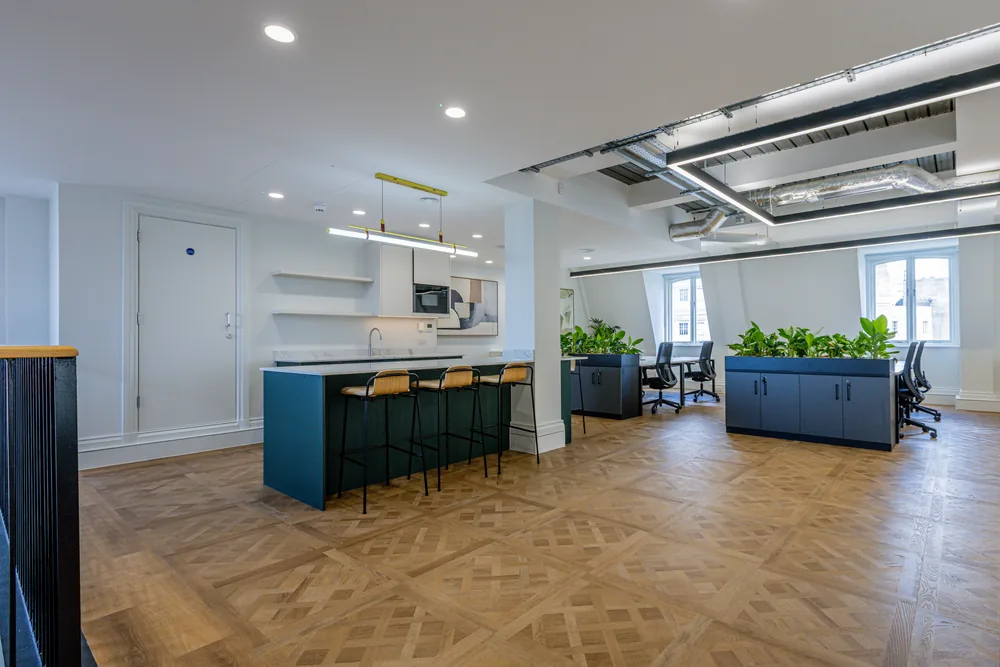
On commercial work, glue-down is the standard. Offices, schools, healthcare and retail floors take rolling loads, trolleys and heavy footfall all day, and a bonded floor is what the commercial ranges are designed and warrantied for. We have laid herringbone wood-effect LVT through open-plan London offices as part of main contractor packages, with the subfloor surveyed and priced up front. Our commercial flooring page covers how we run those jobs, and commercial flooring in London the jobs we have done there.
Sources
- Karndean Designflooring, Gluedown Installation Guidelines (UK), KD5445GLO 04/20: karndean.com
- Karndean Designflooring, Gluedown Installation Guidelines (UK), KD9497GLO, June 2026 (underfloor heating, moisture, subfloors): karndean.com/en-gb/floors/services/installation-guides/
- Karndean Designflooring, What to know about luxury vinyl wear layers, April 2019: karndean.com
- Amtico, Spacia product certification (wear layer and EN ISO 10874 classification): amtico.com
- Guild Floors published prices, fitted and excluding preparation: guildfloors.co.uk/flooring-services/
Questions
Common questions
Is glue-down LVT good?
Yes. It is the most durable way to lay luxury vinyl. Bonded to a properly prepared subfloor, it stays quiet, does not open at the joints, and can be repaired one plank at a time. It is the standard choice for commercial floors and for herringbone.
Is glue-down vinyl better than click?
For kitchens, open-plan areas, underfloor heating, patterns and commercial floors, yes. Click LVT is a reasonable choice for a single room on a floor that is already flat and dry, especially if you may want to lift it later.
Should I use glue or click for vinyl plank flooring?
Decide on the subfloor and the room. If the floor is large, heated, patterned or busy, use glue-down. If it is one small room on a flat, dry floor, click will do the job.
Do you put underlay under glue-down LVT?
No. Glue-down LVT is bonded directly to a primed, smoothed subfloor. Underlay is only used with some click floors, and only the type the manufacturer specifies.
What are the downsides of glue-down vinyl flooring?
It needs a smooth, flat, dry subfloor, which takes more preparation. It takes longer to lay. And it is harder to take up, because the adhesive has to be removed as well as the planks.
Is click LVT more expensive than glue-down?
The click planks often cost more to buy. Glue-down usually costs more to fit, because of the subfloor preparation it needs.
How do you take up glue-down LVT?
The planks are lifted, usually with a floor scraper, and then the adhesive left on the subfloor is removed, typically by grinding. The base then needs re-smoothing before a new floor goes down.
How do you prepare a subfloor for LVT?
Check it is flat to within 3mm over 2m and test concrete for moisture. For glue-down, abrade and prime concrete and apply a smoothing compound at least 3mm thick. Overlay floorboards with 5.5mm flooring grade plywood. Those are Karndean's UK figures, so check the guide for your product.
Choosing LVT for your home or your next fit-out?
We bring the samples to you, check the subfloor, and give you one fixed quotation that includes the preparation.
Or call 01279 942302