

Buying guide
Stair runners: choosing, cost and fitting
A runner leaves the wood showing at each side and puts carpet up the middle. Here is how to choose one that suits your stairs, and what goes into the price.
9.9/10 across 47 Checkatrade reviews
A stair runner is a length of carpet fitted up the middle of the stairs, with the wood left showing at each side. Most people leave about 10cm of wood each side. Wool, flatweave and natural fibres are the usual choices, and flatweave is the one to pick if your stairs turn. The edges are always finished, and stair rods are optional. Get those four decisions right and a runner will make the whole hallway.
We fit runners on period staircases with brass rods, and on new-build stairs where the runner is carried round the turn and across the landing. This guide takes the decisions in order, from width to fitting.
At a glance
- A runner leaves the wood showing at each side. Around 10cm is usual, 5cm is the minimum
- Wool, flatweave and natural fibres are the common choices. Flatweave turns winders best
- The edges are always finished: whipped, taped or bound
- Stair rods are decorative. The runner is held by fixings underneath
- Runner, binding, rods and fitting are separate lines in one fixed quotation
Stair runner or fitted stair carpet?
A fitted stair carpet runs wall to wall and covers every tread and riser. A runner covers the middle of the stairs only, so the wood at each side stays on show.
Choose a runner when the staircase itself is worth looking at. That means a period staircase with good spindles and strings, or new stairs with painted or oak edges you want to keep in view.
Choose fitted carpet when the stairs are plain softwood you would rather not see, or when the carpet carries on into the landing and bedrooms. Which? notes a full stair carpet is plusher and warmer than a runner (Which?, 28 Jan 2026).
The exposed wood is the part people forget. Once the runner is down, the edges of every tread and riser are on show. If they need sanding, painting or staining, that happens before the runner goes in, so we agree who does it at the survey.
How wide should a stair runner be?
Start with the wood you want showing, not the runner. Take the runner width from the stair width and halve it to get the margin each side. Cormar Carpets says most people leave about 10cm each side (Cormar Carpets, accessed 25 Nov 2026), and Roger Oates sets a minimum margin of 5cm (Roger Oates, accessed 25 Nov 2026).
| Stair width | Runner width | Wood each side |
|---|---|---|
| 80cm | 60cm | 10cm |
| 90cm | 70cm | 10cm |
| 100cm | 70cm | 15cm |
| 105cm | 85cm | 10cm |
The runner widths in the table are Roger Oates’ three standard flatweave widths: 60cm, 70cm and 85cm. A runner cut from broadloom carpet can be made to any width.
A narrow staircase often looks wider with a wider runner and a slim margin. A grand staircase usually looks better with more wood on show. Older staircases are rarely the same width all the way up, so we measure at the top and the bottom.
Which material?
Wool. The classic runner. It is naturally hardwearing and recovers well after it is walked on. A loop or short cut pile keeps a crisp edge and holds its shape on the nosing.
Flatweave. No pile, so it is thin, supple and sharp at the edge. Roger Oates recommends flatweave on winders because it bends round the turn, and with at least three winders on a 90 degree turn the stripes can often be matched in the crutch of the step.
Sisal and other natural fibres. A textured, tailored look, and the darker flecks hide dirt. They are firmer underfoot than wool and less forgiving of spills, so they suit adult households better than busy family stairs.
Patterned and striped. Herringbone, stripes and borders are where runners come into their own. A pattern has to run dead straight down every stair, centre on every tread and stay lined up through any turn. That takes more time to fit, and it is the work we enjoy most.
For fibres and pile types in more depth, see our guide to the best carpet for stairs.
Binding and edges
Every runner needs a finished edge, because it is not fitted wall to wall. The edge stops fraying and takes the wear where feet clip it. Cormar’s guide sets out the main choices:
- Whipping. The edge is overlocked with yarn, matched or contrasting. It suits narrow stairs and awkward shapes.
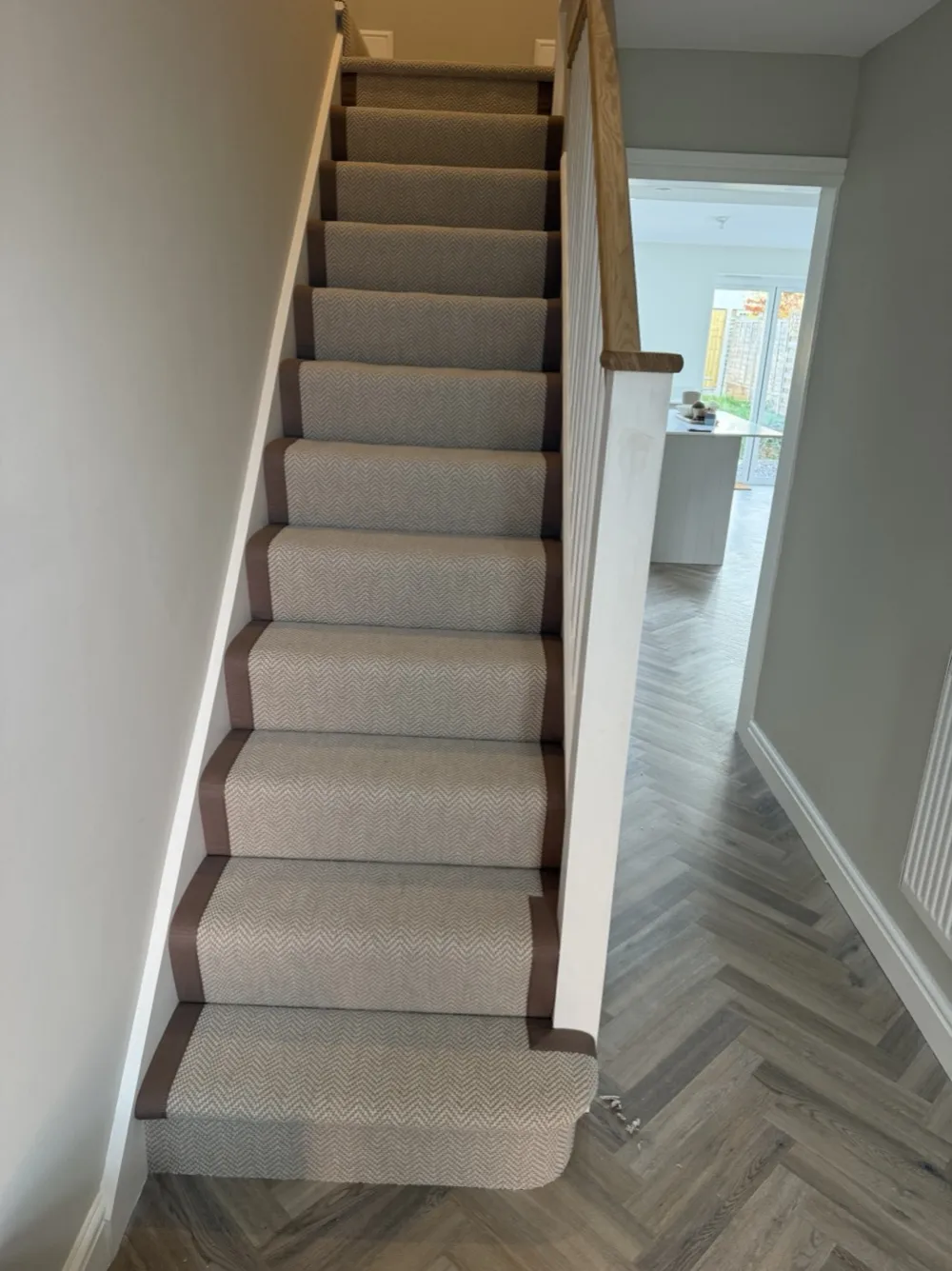
- Taped binding. A cotton, linen, herringbone or leather tape is sewn along each side. Cormar says taped binding suits straight staircases wider than 66cm, because on narrow stairs the tape can be stepped on and wear faster.
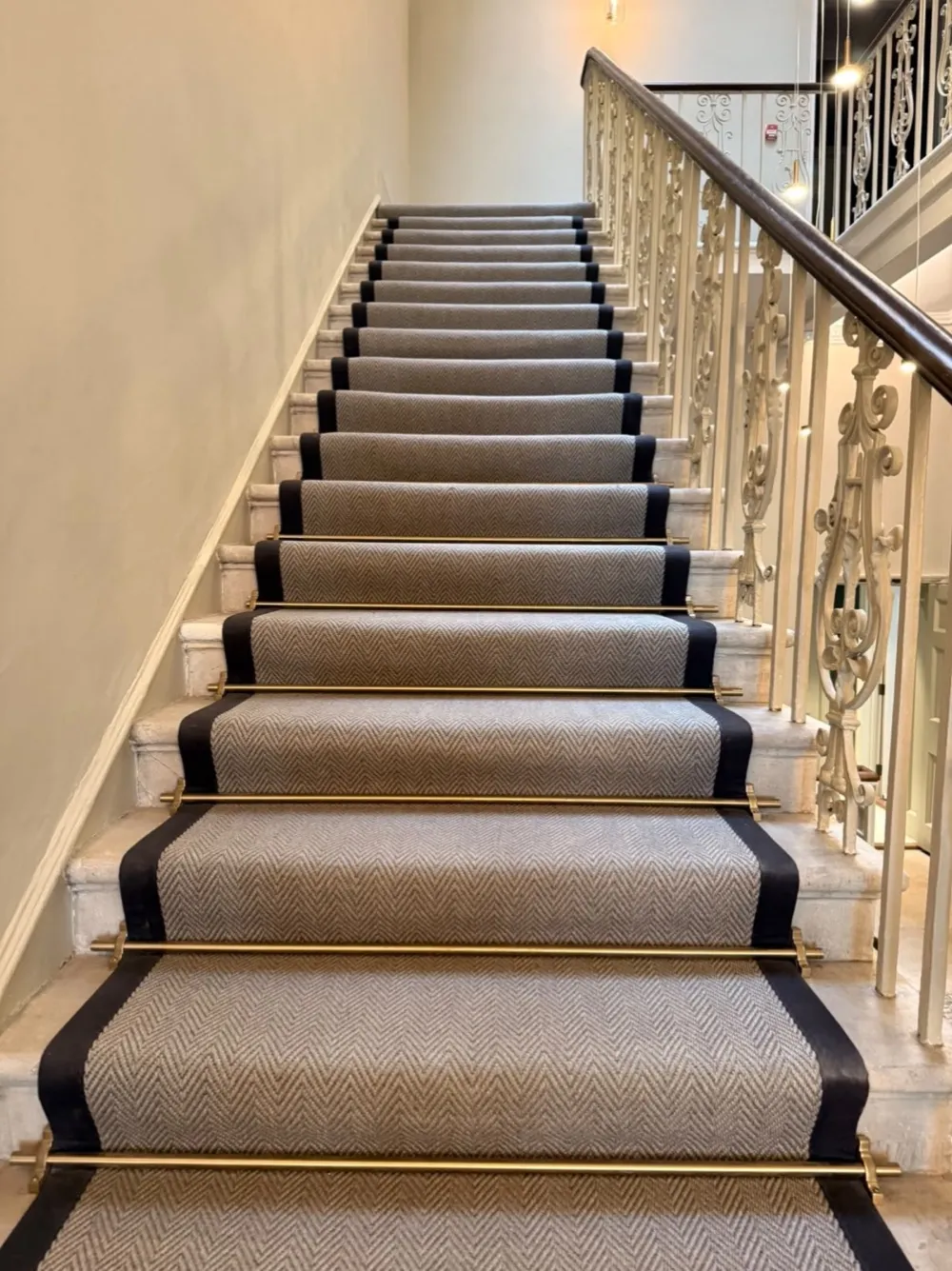
- Woven border. Some runners come with the border woven in, like the navy edge on the runner at the top of this page.
Stair rods, or no rods?
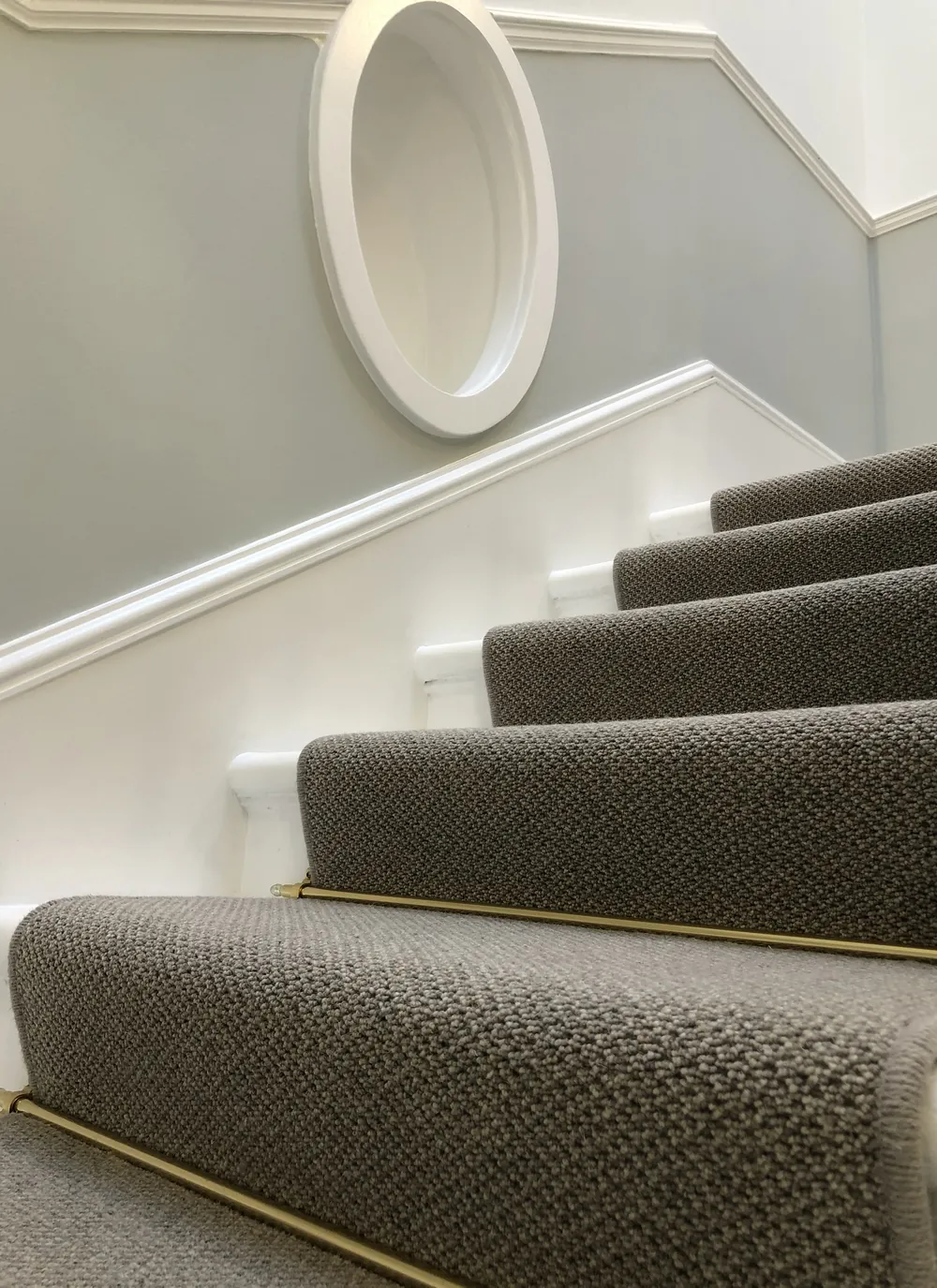
Stair rods do not hold the runner in place. The runner is fixed with gripper at the back of each tread and the foot of each riser. Rods are a finishing detail, and Cormar notes they can be added later.
Brass is the period choice and suits Victorian and Edwardian houses. Black reads as modern and sharp against a pale runner. Chrome and nickel sit well with greys and cool colours.
Rods sit at the back of the tread, so they work best on straight stairs. On winders they are a judgement call, because the back of each tread is a different length and a rod can look out of line. No rods is a choice too. A runner with a woven border or a strong tape edge often looks cleaner without them.
Winders, turns and landings
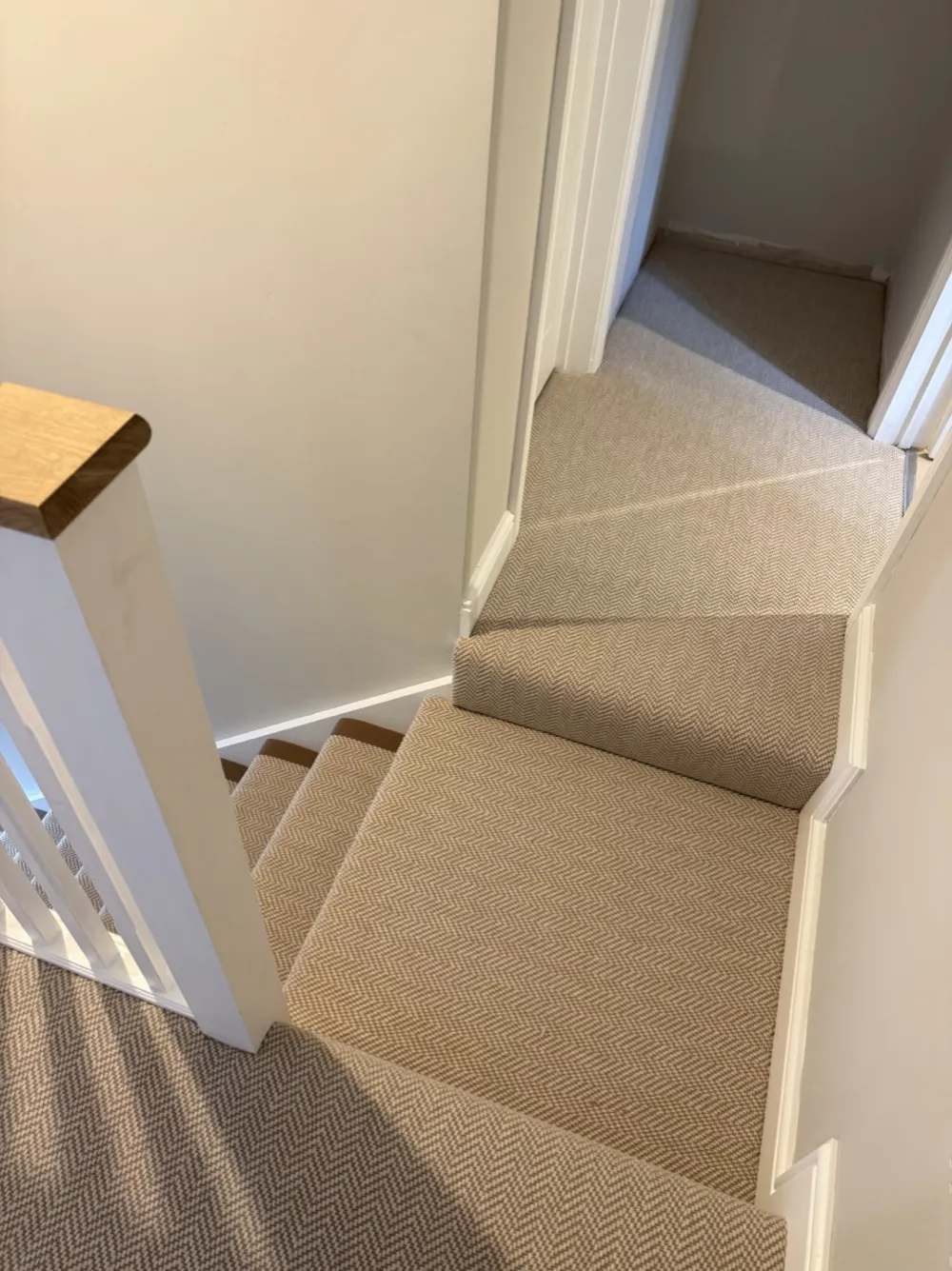
A runner on a turning staircase is where the fitter earns their money. Each winder is a different shape, so the runner is folded and tailored on every step to keep the edges straight and the margin even.
There are three ways to take a runner round a turn:
- Carry it round. The runner is folded on each winder and runs continuously. This needs a supple runner, which is why flatweave is the usual pick.
- Stop and restart. The runner stops at the turn and restarts above it, with the winders carpeted to match or left as wood.
- Fit the turn wall to wall. The winders are carpeted in full and the runner carries on above and below.
At the top, the runner can carry across the landing, the landing can be carpeted wall to wall, or the runner can stop with a loose rug on the landing. Carrying it across looks the most deliberate, and it is how we finish new-build runners where the landing allows.
How a stair runner quote is built
We price a runner as separate lines in one fixed quotation, after a free survey. A runner is quoted on its own lines rather than per square metre, because the edging, rods and hand fitting make up a large share of the job.
| Line on the quote | What decides it |
|---|---|
| The runner | Material, width, and length including any landing |
| Edging | Whipping, tape or binding, priced per metre on both sides |
| Underlay and fixings | A thin, firm underlay cut to the runner width, and gripper on every step |
| Stair rods | Finish and number of rods |
| Fitting | Number of stairs, winders, the landing, and whether the pattern must be matched |
| Taking up the old carpet | Only if there is carpet or old fixings to remove first |
Cormar recommends a thinner, firmer underlay under a runner, because it shows less at the open sides. For measuring and pricing a fully carpeted staircase, see how much to carpet stairs and a landing.
How a stair runner is fitted
We fix the underlay and gripper to each step, set out the centre line so the margin is even from bottom to top, and fit the runner one stair at a time. On period stairs we measure each step separately, because treads are often different depths and worn at the front. There are two ways to dress each stair:
- Waterfall. The runner drops straight from the nosing to the next tread. It suits flatweaves and thicker runners.
- Hollywood. The runner is wrapped tight round each nosing and fixed underneath, so every step has a tailored edge.
Rods go in last. You can walk on the stairs as soon as we have finished.
A stair runner for your home
We fit stair runners in homes across Hertfordshire, Essex, London and the wider South East, including Hertford and Ware, Hoddesdon and Broxbourne, Bishop’s Stortford and the rest of Hertfordshire. For carpet through the rest of the house, our carpet fitting cost guide explains how we price it.
To see runners on your own stairs, book a free survey. We bring samples, measure the stairs and landing, and give you one fixed quotation with every line set out. The price we quote is the price you pay.
Questions
Common questions
How much does a stair runner cost in the UK?
It depends on the runner, the edging, the rods and the shape of the stairs, so we price each of those as its own line. We measure the stairs and landing at a free survey and give you one fixed quotation. The price we quote is the price you pay.
How long a stair runner do I need?
Measure the depth of one tread and the height of one riser, including the nosing, add them together and multiply by the number of stairs. Measure winders round the outside edge and add any landing separately. Roger Oates suggests adding 50cm per flight as a tolerance.
How much wood should show either side of a stair runner?
Around 10cm each side is the usual starting point, and Roger Oates sets a minimum of 5cm. Take the runner width from the stair width and halve it to get your margin. On a wide staircase a bigger margin often looks better.
Are runners more expensive than fitted stair carpet?
A runner uses less carpet, but the edges have to be bound, every tread is dressed by hand and rods are extra. So the gap between a runner and a fitted stair carpet is smaller than the carpet saving suggests. A quote that lists the runner, binding, rods and fitting separately lets you compare the two properly.
Do stair rods hold a runner in place?
No. The runner is held by gripper or tackless fixings on each tread and riser. Stair rods are decorative, and Cormar Carpets notes they can be added later.
Can you install a stair runner yourself?
On a short straight flight with a runner that is already bound, some people do. Winders, landings, patterns and stripes are where it goes wrong, because the runner has to stay square and the pattern has to stay straight through every turn.
Thinking about a stair runner?
We bring runner samples to your home, measure the stairs, and give you one fixed quotation with the runner, binding, rods and fitting on separate lines.
- Tell us the rooms and your postcode.
- We send appointment options within one hour, then survey your home for free, with samples.
- You get one fixed quotation. The price we quote is the price you pay.
Or call 01279 942302