

Buying guide
The best carpet for stairs
Stairs take more wear than any room in the house, and every step bends the carpet over a nosing. Here is what holds up, and what to leave in the showroom.
9.9/10 across 47 Checkatrade reviews
The best carpet for stairs is a short, dense carpet in wool, a wool blend or nylon, made as a twist pile or a tight loop. If you have a dog or cat, choose the twist, because claws catch in loops. Pick a mid-tone or flecked colour, and fit it over a firm underlay rather than a soft one.
Stairs take more wear than any room in the house, and every step bends the carpet over a nosing. A carpet that looks perfect on a lounge floor can wear bald on the stairs in a few years. This guide covers how to choose one that won’t.
At a glance
- Short and dense beats long and soft on stairs
- Wool, an 80/20 wool blend or nylon are the hardest-wearing fibres
- Twist pile is the all-rounder. Loop is hardwearing but snags with pets
- Mid-tones and flecks hide wear far better than pale or very dark plains
- Firm underlay, new gripper, and a fitter who has done your kind of stairs
Wool, synthetics and blends
The fibre decides how the carpet recovers after it has been walked on. Here is how the main fibres compare on stairs.
| Fibre | On stairs | Watch for |
|---|---|---|
| Wool | Naturally hardwearing, recovers well, insulates sound | Less stain-resistant than synthetics, can attract moths |
| Wool blend (80/20) | About 80% wool with a synthetic for strength | Check the pile type as well as the blend |
| Nylon | The most durable synthetic, suits high traffic | Can attract oil-based stains |
| Polyester | Soft, stain-resistant | Prone to flattening, not for high traffic |
| Polypropylene | Stain-resistant and easy to clean | Prone to flattening, attracts oil-based stains |
The fibre notes come from Which?’s guide to carpet types, which also says solution-dyed nylon resists stains and fading best of all (Which?, 28 Jan 2026).
Homebuilding explains the blend most people end up with: an 80/20 carpet is about 80% wool and 20% another fibre, usually synthetic (Homebuilding, 31 Aug 2023). The wool gives the look and the recovery. The synthetic adds strength where feet land.
Our view: for most homes, a good wool or wool-blend twist is the safest stair carpet you can buy. Pure wool suits a period house or a runner. Solution-dyed nylon suits a family that wants to clean hard and often.
Twist, loop or cut pile?
Pile is how the yarn sits on the backing. It matters more on stairs than anywhere else, because the carpet is bent over a nosing on every step.
| Pile | How it behaves on stairs |
|---|---|
| Twist | Tightly twisted cut yarn. Hardwearing, hides dirt and footprints |
| Loop | Uncut loops. Very hardwearing, but snags with pets and can open up on the nosing |
| Berber | Chunky loops with a flecked, knotted look. Hides dirt, but can pull and snag |
| Saxony | Long, soft cut pile. Flattens and shows marks, best kept off stairs |
| Velvet | Short, dense cut pile. Looks luxurious but offers little grip underfoot |
Which? describes twist as smooth, hardwearing and good at hiding dirt, and saxony as a soft, deep pile that flattens easily and is best avoided in busy areas. Homebuilding notes that deep tufted and velvet carpets offer little grip on stairs.
Loop and pets. Loop wears well, which is why it is popular on stairs and halls. The problem is claws. Which? is blunt: loop carpets are a no for pet owners, because claws, especially cats’, catch in the loops, and a pulled loop can run along the row.
Loop on a nosing. When a chunky loop is bent over the front edge of a stair, the rows open up and the backing shows through. The trade calls this grinning. Carpet maker Bremworth says many chunky loop carpets grin on stairs, especially over sharp edges, and recommends a nosing radius of 18mm to 25mm for loop pile (Bremworth fact sheet, 2021). On a crisp, square-edged stair, a twist or a tighter, finer loop is the safer choice.
Pile density and weight
Density is how closely the tufts are packed. On stairs, dense matters more than deep. Which? gives three simple checks:
- The thumb test. Press your thumb into the pile. The faster it springs back, the denser and more resilient the carpet.
- The back of the sample. Bend the sample and look at how tightly the tufts are packed. If you can see a lot of backing, it will show on the nosing too.
- The weight. The pile weight should be printed on the back of the sample. Short, dense, heavy carpets generally last longer than long, loose ones.
Compare weights between carpets of the same pile type. Two twists are directly comparable; a heavy loop and a heavy twist are not. Homebuilding also quotes Alternative Flooring warning that not every wool carpet suits stairs, so we always check the maker’s own rating for stair use.
Underlay for stairs
Underlay on stairs is about firmness, not softness. A soft, thick underlay feels lovely on a bedroom floor. On a stair it lets the carpet flex at the nosing every time someone steps on it, and that is where carpet wears first.
We fit new, firm, dense underlay and new gripper on stairs, with the underlay pulled tight over each nosing. On old, creaky stairs, Which? notes the right underlay also helps with noise.
Patterns, stripes and colour
A pattern on stairs looks wonderful when it is fitted well. A stripe has to run straight down every stair. A herringbone has to sit centred on every tread. On a turning staircase, both have to stay true through every winder. That takes more carpet, because of the pattern repeat, and more time, because every step is set out by eye.
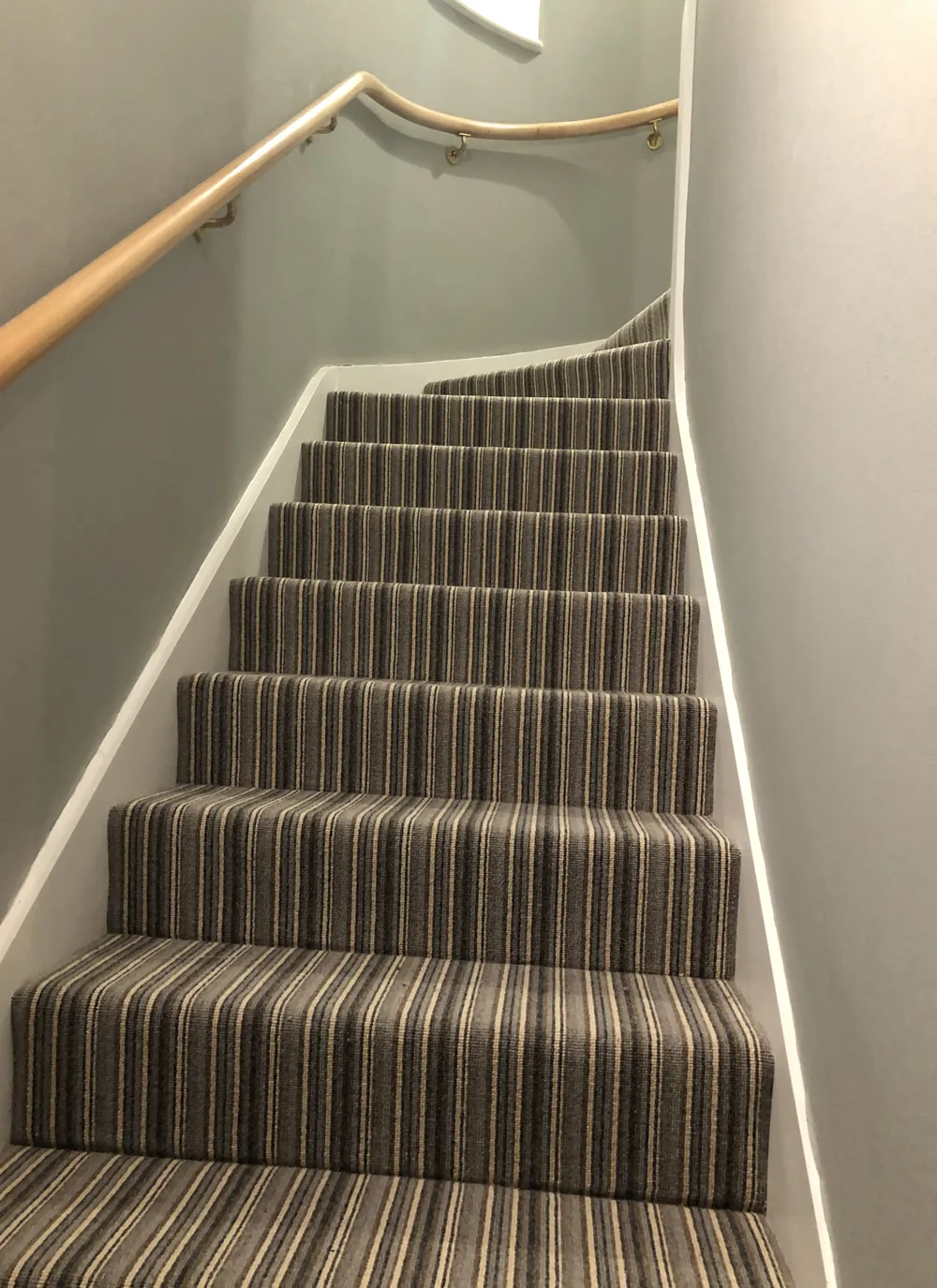
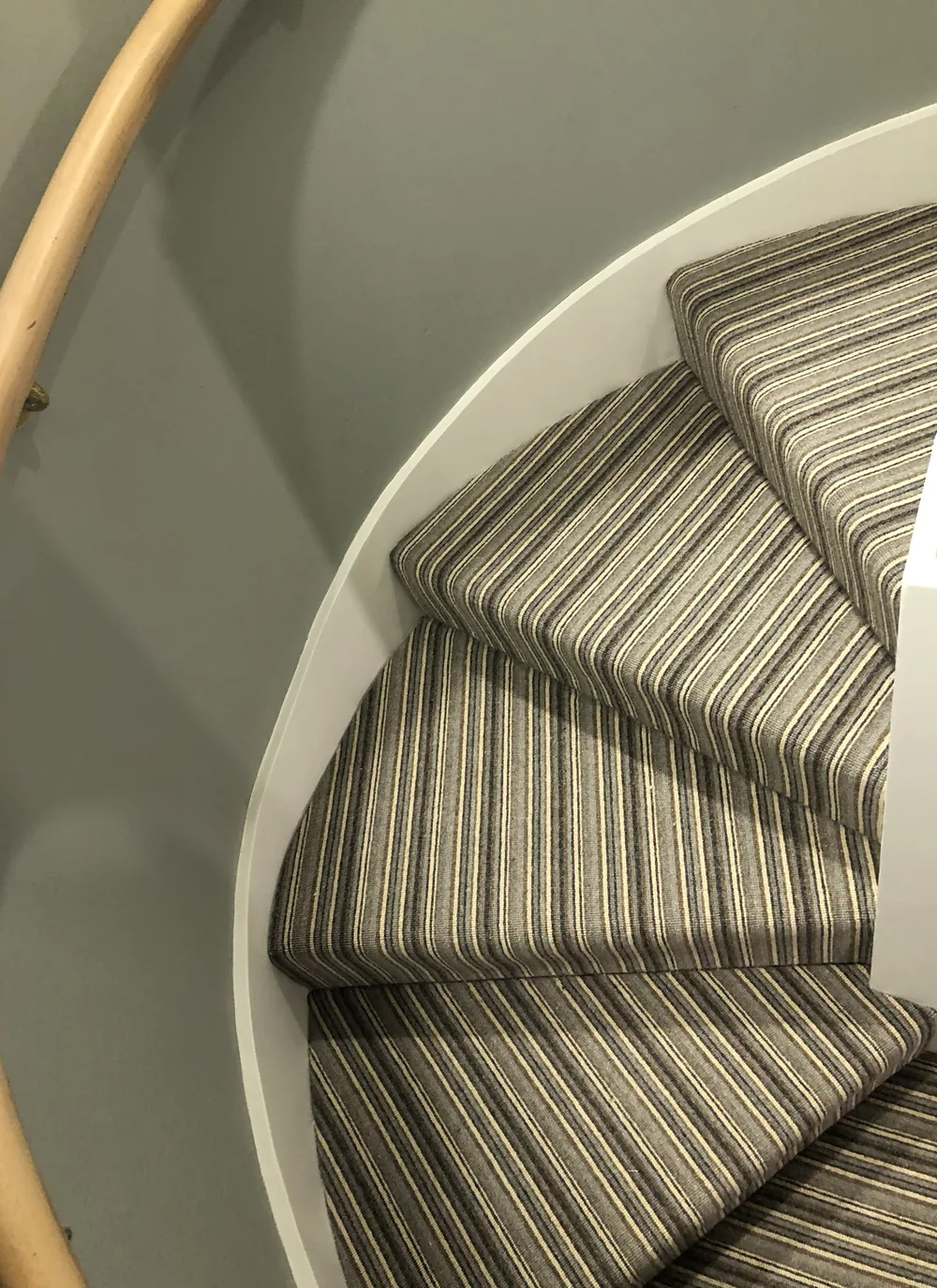
Stairs wear in a narrow band down the middle, and the nosings take most of it. Colour decides how soon you notice.
- Mid-tones such as oatmeal, mushroom, warm grey and stone hide both dirt and fluff.
- Flecked, heathered or small-scale patterns hide the most, a point Homebuilding’s experts also make.
- Very pale plains show the traffic lane down the middle within months.
- Very dark plains show dust, lint and pet hair on every tread.
Lighter or darker than the floor below has no single answer. A stair carpet a shade darker than a pale hall floor tends to look settled. Against a dark wood hall, a lighter, warmer carpet lifts the stairwell. We bring samples so you can see them on your own stairs in daylight and in the evening.
If you want bold pattern with the wood on show, a runner is often the best way to do it. Our stair runner guide covers widths, binding, rods and how runners turn a corner.
Pets and families
For a house with children and a dog, our usual advice is:
- A twist pile, not a loop.
- A wool blend or solution-dyed nylon, depending on how you like to clean.
- A mid-tone or flecked colour.
- A firm underlay, so the nosings don’t wear first.
Leave loop, berber, saxony and very pale plains for the bedrooms.
What to ask a fitter
Ask these before you choose a carpet, and you will know whether the fitter has thought about your stairs. We answer every one at the survey.
- Is this carpet rated for stairs by the maker?
- How will this pile look over my nosings? Ask to see it bent over an edge.
- What underlay will you use on the stairs, and is it new?
- Is new gripper included, or are you reusing the old?
- How will you handle the winders? Each one is cut on its own.
- For a pattern: how will you keep it straight down the flight and round the turn?
For how to measure and how a stair quote is built, see how much to carpet stairs and a landing. Our carpet fitting cost guide covers the rest of the house.
Carpet for your stairs
We carpet stairs and landings across Hertfordshire, Essex, London and the wider South East, including Hertford and Ware, Hoddesdon and Broxbourne, Bishop’s Stortford and the rest of Hertfordshire. See our residential flooring page for stair work we have done, and flooring services for the preparation behind it.
To choose a stair carpet with samples on your own stairs, book a free survey. We measure the stairs and landing and give you one fixed quotation. The price we quote is the price you pay.
Questions
Common questions
What type of carpet is best for high traffic stairs?
A short, dense carpet in wool, a wool blend or nylon, in a twist or a tight loop pile. Which? recommends a low pile, densely made carpet for stairs. Avoid deep, soft piles such as saxony, which flatten quickly where feet land.
Is loop pile carpet good for stairs if you have pets?
Usually not. Which? says loop carpets are a no for pet owners, because claws, especially cats' claws, catch in the loops and pull them. A dense twist pile is the safer choice with pets.
Should stair carpet be lighter or darker than the floor?
Mid-tones usually work best on stairs, whatever the floor below. A very pale carpet shows the tread marks down the middle, and a very dark one shows dust and lint. A flecked or heathered colour hides both.
What should you avoid when buying carpet for stairs?
Avoid deep or loose piles, chunky loops if you have pets, very pale plain colours, and soft underlay. Also avoid any carpet the maker does not rate for stairs, because not every carpet is built to bend over a nosing.
Is wool or synthetic carpet better for stairs?
Both can be. Wool is naturally hardwearing and recovers well, and an 80/20 wool blend adds strength. Nylon is the most durable synthetic, while polyester and polypropylene flatten more easily on stairs.
Should I choose fitted stair carpet or a runner?
Fitted carpet covers every tread and riser wall to wall, so it is warmer and quieter. A runner leaves the wood showing at each side, so it suits a staircase worth looking at. Our stair runner guide covers widths, binding and rods.
Choosing carpet for your stairs?
We bring samples suited to stairs to your home, measure the stairs and landing, and give you one fixed quotation. The price we quote is the price you pay.
- Tell us the rooms and your postcode.
- We send appointment options within one hour, then survey your home for free, with samples.
- You get one fixed quotation. The price we quote is the price you pay.
Or call 01279 942302