

Commercial guide
Best flooring for a commercial gym: what actually survives, and what goes underneath
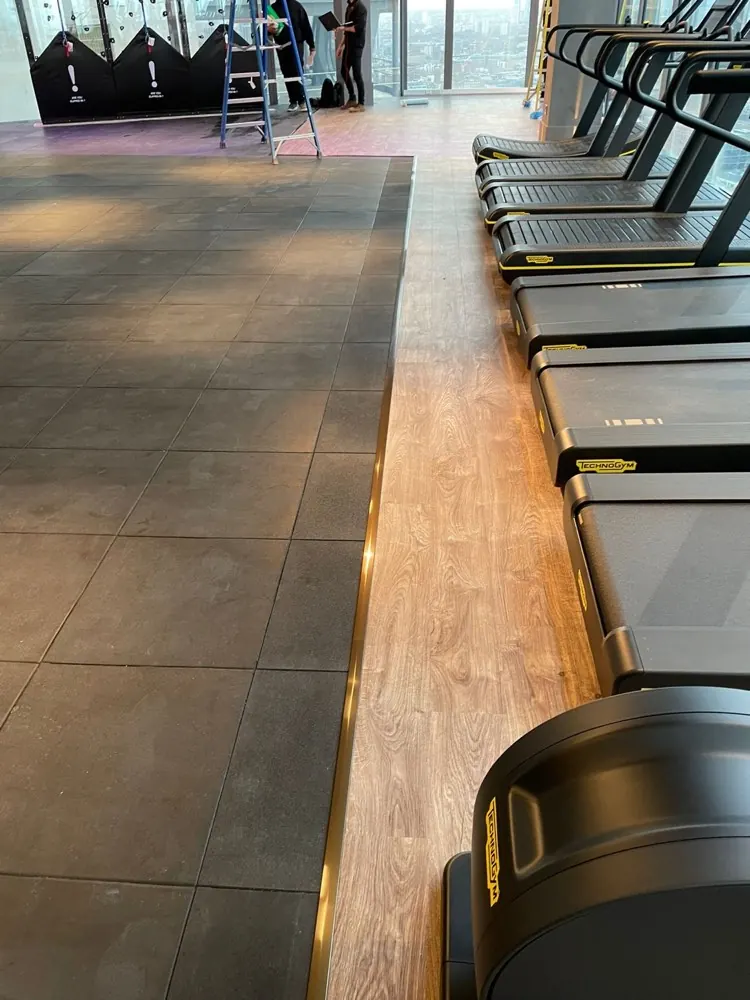
If you are fitting out a commercial gym, the best performance flooring is high-density rubber, laid as tiles or rolls and specified zone by zone. Allow 20 to 40mm of rubber under free weights and 6 to 8mm under cardio machines.
That is the answer most UK guides give, and it matches what we lay. What they say less about is what has to be underneath it, and how you keep the gym open while it goes down. We cover both below.
At a glance
- Rubber is the standard commercial gym floor in the UK, in tiles or rolls
- Thickness follows the load: 6 to 8mm for cardio, 20 to 40mm for free weights, 30mm and up for Olympic lifting
- Rolls suit large open areas. Tiles suit weights areas, because one damaged tile is one tile to replace
- Studios, changing rooms and wet areas usually want vinyl or slip-rated safety flooring
- The subfloor needs to be flat, sound and dry before any of it goes down
- First-floor gyms need the impact and noise to the floor below specified at the start
The floor, zone by zone
A commercial gym is several rooms’ worth of different loads under one roof. The floor works best when each zone is specified for what happens on it.
| Zone | What we would lay | Typical rubber thickness | What it has to cope with |
|---|---|---|---|
| Reception and circulation | Rubber rolls, or entrance matting at the door | 6mm | Footfall, wet shoes, cleaning |
| Cardio | Rubber rolls | 6 to 8mm | The static weight of treadmills and bikes |
| Studio and stretching | Rubber, or a sports vinyl | 7 to 10mm | Bare feet, mats, bodyweight work |
| Functional training and rigs | Rubber tiles, with turf for sled lanes | 10 to 20mm | Kettlebells, sleds, a rig bolted through the floor |
| Free weights | Heavy-duty rubber tiles | 20 to 40mm | Dropped dumbbells and plates |
| Olympic lifting | Platforms or heavy tiles | 30mm and up | Barbells dropped from overhead |
| Changing rooms and showers | Slip-rated safety vinyl, cap-and-cove | Not rubber | Standing water and hygiene |
The thickness ranges are the ones published in Indigo Fitness’s UK guide to commercial gym flooring, and they are a sound starting point. The right figure for your free weights area depends on the heaviest thing your members will drop and how high they will drop it from.
More thickness is not always better. Over-cushioned rubber under a treadmill or a balance station makes the kit less stable. Match the thickness to the load in each zone.
Rubber tiles or rubber rolls?
Both are rubber. The difference is how they are laid and how you repair them.
| Rubber rolls | Rubber tiles | |
|---|---|---|
| Best for | Large open areas: cardio, circulation, studios | Free weights, lifting areas, high-wear spots |
| Thickness | Usually the thinner end | Available much thicker, for drop zones |
| Seams | Fewer, so the floor reads as one surface | More joints, interlocking or butted |
| Fixing | Usually bonded to the subfloor with adhesive | Bonded, or interlocking on some ranges |
| Repair | Cut out and patch a section | Lift and replace the damaged tile |
Most commercial gyms end up with both. Rolls through the cardio and circulation areas, and tiles where the weights are.
EPDM, SBR and vulcanised rubber: what the words mean
You will see these on every supplier’s page. In plain English:
- SBR is recycled rubber, usually from tyres, made into granules and bonded into tiles and rolls. It is the black base of most gym flooring
- EPDM is a coloured rubber granule. It is usually mixed into SBR as flecks, which is where the speckled look comes from
- Vulcanised rubber is cured under heat and pressure, which makes it denser and harder-wearing. It is what Indigo Fitness recommends as the commercial default
- Poured polyurethane is a seamless floor poured on site. It suits some sports halls and studios. It takes longer to install and cure than a rubber floor
Is vinyl flooring good for gyms?
Yes, in the right zones. Vinyl suits studios, physio and treatment rooms, corridors and changing areas, where you want an easy-clean surface and no rubber smell. It is the wrong choice under free weights, where a dropped plate will dent or split it.
In changing rooms and showers we fit slip-rated safety vinyl, turned up the wall as cap-and-cove so there is no joint at the skirting for water to get into. If you are choosing vinyl or LVT for a studio or reception, the wear layer is the figure to check, which we explain in our glue-down or click LVT guide.
What goes under gym flooring?
The subfloor. It needs to be flat, sound and dry before any rubber goes down, and it is the part most gym flooring guides leave until last.
- Flat. Most manufacturers want the subfloor within 3mm over a 2 metre span. Our guide to whether a subfloor needs levelling shows how to check it
- Sound. A rig bolted through the floor, a run of heavy machines or a lifting platform puts concentrated load on one spot. Cracked or hollow screed under that spot gets worse
- Dry. Rubber is bonded with adhesive, and adhesive fails over a damp slab. On commercial work we test moisture as standard
On an uneven base, heavy kit rocks and tile edges do not sit flat. We survey the subfloor and price the preparation before work starts, so it does not arrive as a variation halfway through your programme.
Noise and the floor below
If your gym is on an upper floor, or shares a building with offices or flats, the noise of a dropped weight is often the first complaint. Ask your landlord or building manager early whether the lease sets an acoustic requirement.
Thicker, denser rubber absorbs more of the impact. Some ranges are made specifically to reduce sound transmission, with acoustic backing or a separate acoustic layer underneath. Indigo Fitness, for example, states that its own acoustic tiles reduce sound transmission by up to 38 decibels. Which system you need depends on the building, the floor construction and what sits below, so we specify it at survey with the rest of the floor.
What does commercial gym flooring cost?
The honest answer is that it depends on the zones. A gym that is mostly cardio and circulation costs far less per square metre than one built around free weights and lifting platforms, because the rubber under cardio is a fraction of the thickness needed under weights.
Rubber is priced at survey, because the thickness, and so the price, changes zone by zone. What we can give you today:
- Slip-rated safety vinyl, cap-and-cove, for changing rooms and wet areas: from £70/m² fitted, excluding preparation
- Commercial vinyl for studios and corridors: from £70 to £100/m² fitted, excluding preparation
- Subfloor preparation: priced at survey, never assumed
Three things move the total more than anything else: how much of the floor is heavy-weights zone, what the subfloor needs, and whether the work has to happen out of hours.
How long it takes, and keeping the gym open
You do not have to close the whole gym. We plan out-of-hours, weekend and phased installs from the survey, so one zone is fitted while the rest stays open. On a new fit-out we work to the main contractor’s programme, with one point of contact from survey to handover. For London jobs, see our commercial flooring in London page.
The gyms we have fitted
We fitted the floor in a championship boxing gym in London: 300m² of rubber, wood and vinyl, delivered as part of a main contractor package. Across the business we have completed over 300 commercial projects, carry £5m public liability, and hold CSCS cards across the team with SSSTS site supervision. More on how we run commercial packages is on our commercial flooring page.
Sources
- Indigo Fitness, Best Commercial Gym Flooring: A Complete UK Guide, 26 August 2026: indigofitness.com/blog/best-commercial-gym-flooring/
- Guild Floors published prices, fitted and excluding preparation: guildfloors.co.uk/flooring-services/
Questions
Common questions
What type of flooring is best for a gym?
For a commercial gym, high-density rubber is the best all-round floor. Use 20 to 40mm rubber tiles under free weights, 6 to 8mm rubber rolls under cardio, rubber or sports vinyl in studios, and slip-rated safety vinyl in changing rooms.
What thickness of rubber do you need for free weights?
Between 20 and 40mm for a general free weights area, and 30mm and up where barbells are dropped from overhead, according to Indigo Fitness's UK guide. The right figure depends on the heaviest weight dropped and the height it falls from.
Should commercial gym flooring be rubber tiles or rolls?
Usually both. Rolls give a near-seamless floor across large cardio and circulation areas. Tiles come thicker for weights areas, and one damaged tile can be lifted and replaced.
Is vinyl flooring good for gyms?
Yes for studios, treatment rooms, corridors and changing areas. No for free weights, where a dropped plate will damage it. In wet areas, use slip-rated safety vinyl with cap-and-cove at the walls.
What goes under gym flooring?
A subfloor that is flat, sound and dry. Most manufacturers want it within 3mm over 2 metres. Concrete should be moisture tested before rubber is bonded to it, and any cracked or hollow screed repaired first, especially under rigs and lifting platforms.
Can you fit gym flooring without closing the gym?
Yes. We plan out-of-hours, weekend and phased installs, fitting one zone at a time while the rest of the gym keeps trading.
Planning a gym fit-out in Hertfordshire, Essex or London?
Send us the floor plan and the zones you have in mind, and we will survey the subfloor and give you one fixed quotation for the whole floor.
Or call 01279 942302